
Drift 2 Drag
HyperMonk GamesRacing
4.51.65K Reviews
- Version
- 5.3.3
- Installs
- 10.00M
- Age Rating
- Everyone
Screenshots
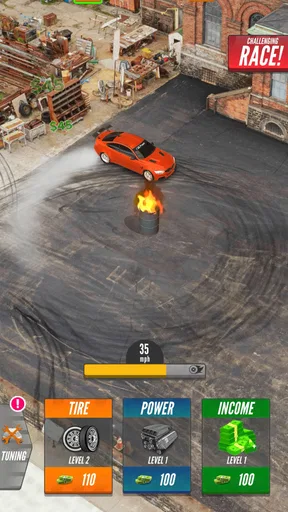
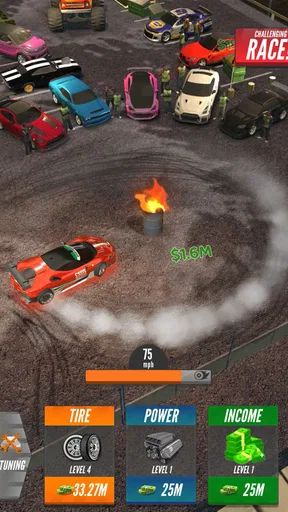
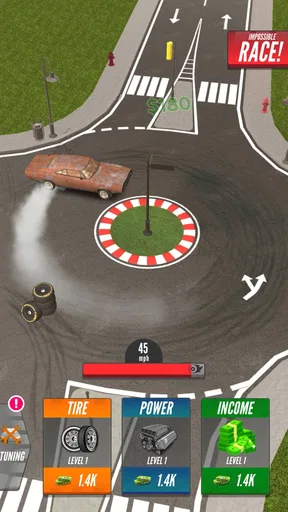
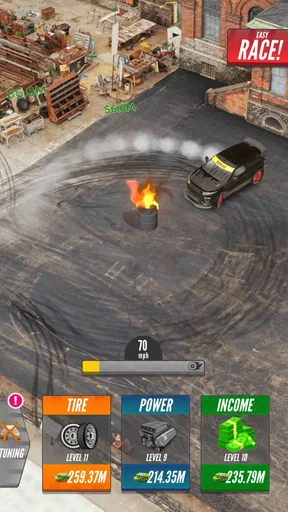
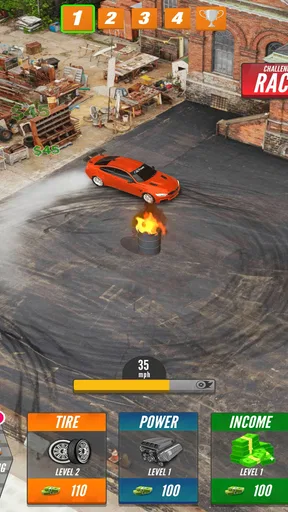
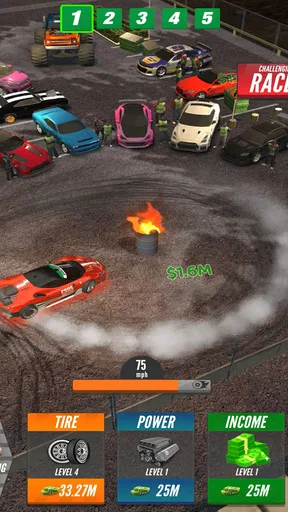
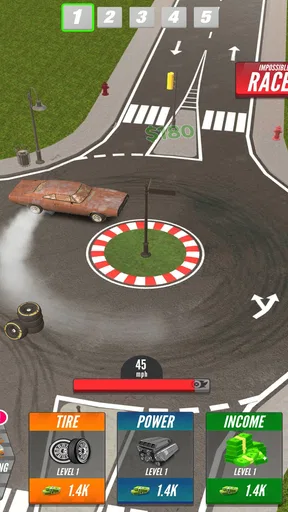
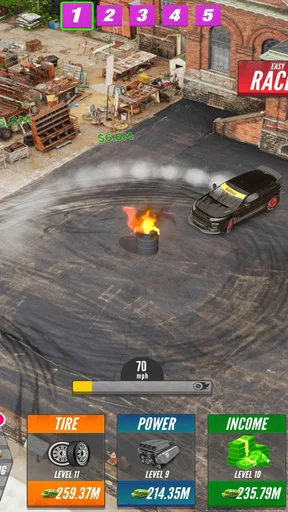
Our Review of Drift 2 Drag
 Analysis by Appyee
Drift 2 Drag is the kind of racing game I open when I want a quick burst of concentration rather than a long driving session. Its central idea is easy to understand: control a car through a drift-focused race, then use that momentum to get the better run. That simplicity makes the first few minutes approachable, but the timing becomes much less forgiving once I stop treating every turn as something to rush through.
Developed by HyperMonk Games, this free racing game has built a sizeable audience, with more than ten million installs and an average rating of 4.6 from roughly 185,000 ratings. Those figures suggest that its short-session format works for many players, although popularity does not remove the need to adjust to its control style. I found the game most enjoyable after I stopped trying to drive it like a conventional racing title.
Getting past the first points of friction
The first place I expect many players to get stuck is the basic relationship between drifting and speed. In an ordinary racing game, I usually try to brake before a corner, turn cleanly, and accelerate as soon as the car is lined up. Here, that instinct can produce a cautious run that feels controlled but does not perform well. The game’s identity is built around using the slide itself as part of the race, so a perfectly tidy line is not always the most useful one.
I had better results by making smaller corrections and watching how quickly the car responds instead of holding a direction for too long. A long input can turn a manageable slide into an oversteer problem, especially when I am already focused on the finish. My practical tip is to learn the length of a brief correction before attempting a faster run. That gives me a reference point for recovering from a wide drift without panicking and making an even larger movement.
The short description, “Drift 2 Drag,” points toward the unusual balance at the heart of the game: drifting is not merely decoration between straight sections. It is the action I need to understand if I want consistent results. Players who prefer a traditional circuit racer with detailed braking, multiple racing lines, and long strategic events may find this approach too narrow. Players who enjoy repeating a compact challenge until their timing improves are more likely to settle in quickly.
Another common sticking point is judging a run by its ending alone. I sometimes reached the finish thinking the attempt had failed, only to realize that the opening section had been much cleaner than usual. That matters because improvement here is easier to notice when I separate the race into moments: entry, slide, correction, and exit. Looking at the whole attempt as one success or failure hides the part of my technique that actually needs work.
What to check before blaming the game
Before deciding that the controls feel broken, I would check the simple things first. My device needs to run Android 7.1 or later, and the current version is 5.2.8. If the game behaves strangely after installation, I would confirm that the operating system meets that requirement, that the installation completed properly, and that the device has enough free space for normal app operation. These are unglamorous checks, but they prevent a control complaint from being confused with a setup problem.
I would also close demanding apps running in the background, restart the game, and test again with a stable connection if a screen fails to load or a session does not behave normally. I would not immediately reinstall after a single bad attempt. First I would fully close the game, reopen it, and see whether the same issue appears in a fresh run. That sequence is safer and faster than repeatedly changing settings without knowing what changed the result.
The game is free to download, which makes trying it easy, but it includes optional in-app purchases ranging from $1.99 to $99.99 per item. I recommend treating the purchase screen as a separate decision from the driving itself. A new player should first decide whether the core racing loop feels satisfying without spending money. If the game is not enjoyable during those first sessions, buying something is unlikely to fix the underlying mismatch between the player and the controls.
Because the content rating is Everyone, it is accessible to a broad audience. That does not mean every player will find the pace comfortable. Younger or less experienced players may need time to understand that repeated attempts are part of the design, while adults looking for a relaxed game may prefer something with less emphasis on precise reactions. The age rating describes accessibility, not difficulty or personal fit.
A recovery routine that saves a frustrating session
When a run goes badly, I use a simple recovery routine instead of immediately restarting again and again. I first identify the earliest point where control was lost. Then I replay with one change only: a shorter input, a later correction, or a slower approach into that section. Changing everything at once makes it impossible to know what helped, while one deliberate adjustment turns repetition into practice.
This is especially useful when the car begins to drift wider than expected. My first instinct used to be a large counter-movement, but that often created a second mistake. A gentler correction gives me more time to see whether the car is already coming back toward the intended path. If the run is still poor, I restart with a more conservative entry rather than trying to rescue an impossible angle at the last moment.
I also recommend separating practice from score chasing. On a practice attempt, I care about surviving the difficult section and reaching the next one with a stable line. On a score attempt, I can then use the knowledge gained from that safer run. This two-step workflow is more efficient than demanding a perfect result immediately, particularly for players who become tense when every attempt feels like a final test.
One non-obvious advantage of short racing sessions is that they make this method practical. I can use a few spare minutes to focus on one weakness without committing to a long event. The trade-off is that repetition can feel monotonous if I need more variety. That is where the game’s compact design either works for me or becomes its biggest limitation: I enjoy refining timing, but I would not choose it as my only racing game.
When the problem is really the device or connection
Not every interruption is caused by the game. If other apps are also slow, screens are freezing across the device, or touch input is inconsistent outside the game, I would investigate the phone or tablet first. A restart, closing background apps, and checking for available system updates are sensible general steps. If the issue affects only one account or installation, I would avoid clearing data impulsively because that can remove local progress or settings.
Connection trouble can also look like a gameplay fault. If a page takes unusually long to appear or a session fails while other online apps are struggling, I would switch between a reliable Wi-Fi connection and mobile data where appropriate, then reopen the game. I would test only after the connection has stabilized. Repeated taps during a delay can make the interface feel unresponsive even when it is simply waiting for a response.
Touchscreen conditions matter more than many players expect in a timing-based racer. A wet screen, a thick screen protector, or a finger resting too close to the active area can change the feel of a short input. I get more consistent results with a clean, dry screen and a grip that lets my thumb or finger move freely. This is a small practical detail, but it can explain why the same control seems accurate one session and sloppy the next.
If the game closes repeatedly while other apps work normally, I would restart the device and check that the installation is current before attempting more drastic steps. I would also avoid running it while the device is unusually hot or nearly out of battery, since general device performance can deteriorate in those conditions. These checks do not guarantee a solution, but they narrow the cause without inventing complicated fixes.
How it compares with familiar racing alternatives
Compared with a conventional circuit racer, Drift 2 Drag feels more focused on a single skill than on building a complete motorsport simulation. I do not approach it expecting realistic race strategy, deep vehicle setup, or the broad variety of a large racing package. Its appeal is the immediate question of whether I can manage the slide and finish the run cleanly. That makes it easier to pick up for a short break, but less suitable for someone who wants extensive customization or a long progression journey.
Compared with endless driving games, it offers a clearer sense of a specific attempt. I am not simply steering until I make a mistake; I am trying to improve a repeatable run. That structure is useful for players who like measurable personal progress, even when the session itself is brief. On the other hand, endless games can feel more relaxed because they do not always demand the same concentration at a particular corner.
Compared with arcade racers built around constant speed and spectacle, this game asks me to pay attention to control quality. A flashy moment is not automatically a good one if it leaves the car badly positioned. I prefer that emphasis when I am in the mood to practice, but I would choose a more forgiving arcade racer when I want to play casually without analyzing every correction.
The purchase model is another practical difference from fully paid racing games. Since the download is free, the barrier to testing it is low, but optional purchases can make the overall experience feel less straightforward for players who prefer to pay once and avoid transaction prompts. That does not make the game unsuitable, but it is worth deciding in advance whether I am comfortable with that model.
Who will enjoy it, and who should skip it
I would recommend this game to someone who likes quick retries, tactile timing, and the satisfaction of turning an awkward corner into a reliable one. It is also a good fit for a player who wants a racing game that can be played in short sessions without requiring a large commitment. The free entry point makes it easy to test, and the Everyone rating means it is broadly accessible from a content perspective.
I would be more cautious about recommending it to someone who wants a realistic driving experience, extensive car management, or a relaxed game that can be played without repeated concentration. I would also steer away from it for a player who dislikes restarting after a small mistake. The game’s central challenge depends on accepting repetition, and no amount of enthusiasm from me changes that basic demand.
For a realistic everyday scenario, I can imagine playing it during a short commute break or while waiting for an appointment. I would begin with a couple of runs aimed only at learning the timing, then use the remaining minutes to repeat the section that caused trouble. That is a better use of the game than opening it while distracted, because divided attention makes small control errors feel random and can lead to unfairly blaming the app.
My practical verdict after settling into the controls
After spending time with Drift 2 Drag, my opinion is positive but specific. It succeeds when I treat it as a focused drift-racing challenge, not as a replacement for every kind of racing game. The core loop is approachable, yet it rewards patience more than frantic movement. The most useful improvement is learning to make small, intentional corrections and judging each attempt by the section that actually went wrong.
HyperMonk Games has made a free racing game that is easy to try and easy to understand, while still giving skilled players a reason to repeat a run. Its broad audience and strong average rating reflect that accessible starting point, but the real question is whether I enjoy practicing one driving skill again and again. For me, the answer is yes in short sessions, especially when I want a compact challenge rather than a full racing career.
My recommendation is to install it, test the controls without making a purchase, and give yourself several deliberate attempts before deciding. If the drifting begins to feel satisfying once the initial friction is gone, Drift 2 Drag can become a rewarding little racing break. If you are looking for detailed simulation, broad vehicle variety, or a completely hands-off casual experience, another racing option will probably suit you better.
Privacy and Permissions
See what permissions an app requests and how it handles your data.
- Wi-Fi connection information
- view Wi-Fi connections
- Other
- view network connections, full network access, control vibration, prevent device from sleeping, Google Play license check
Verdict
Strengths of Drift 2 Drag
- Responsive controls make drifting feel smooth and satisfying.
- Short races are ideal for quick gaming sessions.
- Car upgrades add useful progression and replay value.
- Stylized visuals run well on many modern devices.
- Online competition gives skilled players extra motivation.
Limitations of Drift 2 Drag
- Some upgrades may require considerable grinding to unlock.
- Precision drifting can feel difficult for newcomers at first.
- Limited track variety may reduce long-term freshness.
- Online features depend on a stable internet connection.
- Ads or in-app purchases may interrupt the overall flow.
Other Releases by HyperMonk Games
View All
Highway Overtake - Car Racing
Racing4.3

Drive 2 Climb: Offroad 4x4
Racing4.1

Highway Drift - Car Racing
Racing4.6
Similar Picks in This Category
View All
Hill Climb Racing
Fingersoft4.3

Dr. Driving
SUD Inc.4.2

Traffic Rider
skgames4.5

Asphalt 8 - Car Racing Game
Gameloft SE4.6

Race Master 3D: Car Racing
Beresnev Games4.6

Extreme Car Driving Simulator
AxesInMotion Racing4.3
Frequently Asked Questions
What is Drift 2 Drag, and how does the gameplay work?
Drift 2 Drag combines drifting challenges with drag-racing events in a fast-paced driving game. You can slide through corners to earn points, then compete in straight-line races where timing, acceleration, and gear changes matter. The two racing styles make the experience more varied than a standard drag racer, although players who prefer realistic simulation may find the handling more arcade-oriented.
Can I play Drift 2 Drag offline?
Drift 2 Drag may offer some single-player content without a constant internet connection, but online features, advertisements, cloud-related services, updates, and certain competitive events can require access to the internet. Before traveling or playing with limited data, it is best to test the game in airplane mode. Offline availability can also change after updates, so check the current store description for the latest details.
Does Drift 2 Drag include in-app purchases or advertisements?
As with many free mobile racing games, Drift 2 Drag can include advertising and optional in-app purchases. These may be used to unlock vehicles, improve performance, obtain currency, or speed up progression. You can usually play without spending money, but progress may feel slower if you avoid purchases. Review the payment settings on your Android or iOS device, especially if children may access the game.
What devices are compatible with Drift 2 Drag?
Compatibility depends on the operating system version, device hardware, and the version of Drift 2 Drag available in your region. The game should run best on relatively recent phones and tablets with sufficient free storage and memory. Older devices may experience longer loading times, reduced graphics quality, overheating, or frame-rate drops. Always check the official Google Play or App Store listing before downloading.
Is Drift 2 Drag suitable for beginners?
Drift 2 Drag is generally approachable for beginners because its arcade-style controls are easier to learn than a full driving simulator. New players can practice steering, drifting, acceleration, and timing before attempting more demanding races. However, upgrading the right vehicle parts and learning each event’s requirements becomes increasingly important. Players who dislike repeated races or progression based on upgrades may find the later stages less forgiving.
Play our best games!


